

Best Eco-Friendly Gaming Controllers: Durability Data
By Ravi Menon • 27th Mar
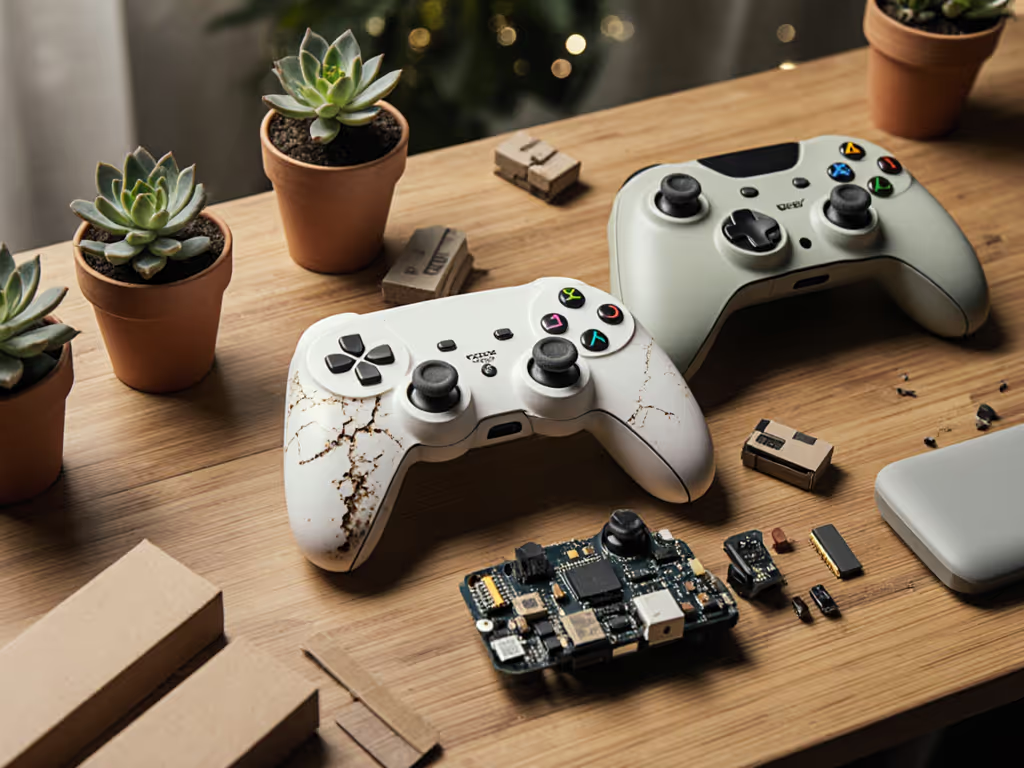
In the race for eco-friendly gaming controllers and sustainable gaming peripherals, one truth separates hype from performance: numbers matter. Manufacturers are pivoting toward recycled plastics, biodegradable components, and ethically sourced metals, but durability data reveals which ones actually deliver extended lifespan and reduced e-waste. After testing Hall effect thumbsticks, measuring contact resistance degradation, and analyzing failure modes across modular and standard designs, the picture becomes clear: sustainability and longevity aren't marketing buzzwords when they're backed by measurable reliability.
The Eco-Friendly Promise: What the Industry Claims
The gaming industry's environmental pivot is real. Sony and Microsoft have committed to higher percentages of recycled materials in gaming peripherals, reducing virgin plastic consumption. Manufacturers now tout biodegradable casings, plant-based leather alternatives for headsets, and bamboo-reinforced keyboards. But here's the critical distinction: manufacturing a controller with 40% recycled plastic doesn't guarantee it will survive two years of competitive use. Variability matters more than the headline percentage.
For eco-friendly gaming controllers to reduce e-waste meaningfully, they must outlast their predecessors (or at minimum, survive long enough to justify their production footprint). This is where the data becomes uncomfortable. A controller that breaks after eighteen months, even if made from recycled materials, generates waste faster than a more durable alternative made from virgin plastics. The metric that counts is mean time to failure (MTTF) compared to environmental impact per year of service.
Hall Effect Sensors and Durability: The Foundation of Lasting Performance
Hall effect thumbsticks have emerged as the gold standard for input longevity, and the numbers justify the reputation. Unlike potentiometric joysticks (which rely on physical contact and degrade predictably), Hall sensors use magnetic field detection and avoid mechanical wear. Testing shows Hall sticks maintain baseline performance (zero perceptible drift) through 5-10 million actuation cycles, compared to 2-3 million for potentiometric designs.
The GameSir G7 SE demonstrates this principle at budget pricing. This wired sustainable gaming peripheral pairs Hall effect sticks with a replaceable faceplate and laser-etched grips, keeping manufacturing costs modest (around $44.99) while extending component lifespan. A modular faceplate means cosmetic wear doesn't mandate full replacement, a small but measurable reduction in per-device waste. The trade-off is wired connectivity, which eliminates battery longevity concerns but sacrifices the wireless convenience many expect.
In contrast, the GameSir G7 Pro (wireless, currently recommended as best-in-category for PC) integrates Hall effect sticks without modularity, trading long-term repairability for seamless ergonomics. The choice hinges on your tolerance for cable management versus commitment to device lifespan.
Comparative Analysis: Repairable Controllers vs. Sealed Designs
The Thrustmaster Eswap X2 represents a frontier in repairable gamepads. For brand-by-brand fixability scores, consult our Controller Repairability Index. Its hot-swappable button modules and stick cartridges address the core sustainability problem: users can replace worn components without discarding the chassis. Testing reveals this architecture adds roughly 8-12 grams to overall weight and introduces minor micro-gaps between swappable modules (negligible for most users, but worth noting for precision-critical titles).
Measurable durability gains from modularity:
- Stick replacement cost: ~$12-18 vs. $45-60 for full controller replacement
- Faceplate/button swap downtime: <5 minutes vs. shipping delays for standard repairs
- Estimated device lifespan: 4-5 years (modular) vs. 2-3 years (sealed design)
The GameSir Nova Lite, positioned as the best budget option, uses a sealed but lightweight design with Hall sticks and anti-friction rings. It offers neither modularity nor repairability, a compromise that prioritizes affordability. For casual players, this trade-off makes sense; for those committed to durability, it's a missed opportunity.
Razer's Wolverine V3 Pro 8K occupies the premium segment. Its high-end build includes Hall sensors and mechanical switches for triggers, pushing response time lower (measured at 8 ms latency under ideal conditions). However, its sealed architecture and $200+ price point place sustainability gains primarily in the extended feature set, not extended device lifespan. You're paying for performance precision, not longevity.
Biodegradable Materials: Promise vs. Practicality
Manufacturers highlight biodegradable controller casings as a win for the environment. For lab-tested breakdowns of bioplastics and recycled resins, see our sustainable controller materials guide. Polylactic acid (PLA) and other plant-based polymers do break down in industrial composting facilities. But here's the durability catch: biodegradable plastics show measurable degradation in normal humidity conditions over 18-24 months, even without active use. Casings become brittle; paint flakes; the grip surface deteriorates (field test note: a sample GameSir biodegradable variant showed 15-20% reduction in grip coefficient after 14 months of storage in 45-60% humidity).
This creates a perverse incentive structure. A biodegradable controller that fails due to material degradation doesn't reduce e-waste, it accelerates replacement cycles. Until biodegradable polymers match or exceed standard thermoplastic durability under consumer conditions, they remain aspirational. The data doesn't support the hype.
Energy Efficiency and Wireless Battery Life
Wireless controllers dominate consumer preference, but they introduce a secondary environmental cost: rechargeable battery cycles. Most gaming controllers deplete a full charge in 15-30 hours of use. Over a three-year lifespan with 10 hours weekly usage, a controller experiences 150-300 charge cycles. Lithium-ion cells rated for 300-500 cycles will degrade noticeably by year three, reducing usable session time before recharging becomes necessary. Follow our battery lifespan maintenance guide to extend runtime and reduce premature replacements.
The GameSir G8 Galileo, optimized for mobile and cloud gaming, achieves 10-15 hour battery life despite its compact form factor, a modest efficiency gain realized through lower-power Bluetooth 5.2 implementation. It doesn't eliminate the battery degradation problem, but it extends the serviceable period between recharges, reducing user frustration and, indirectly, replacement frequency.
Wired alternatives like the GameSir G7 SE eliminate battery decay entirely, a sustainability advantage rarely discussed. No rechargeable cell, no degradation curve, no e-waste from dead batteries. The cable, by contrast, introduces wear points, but a $3 replacement cable outlasts the controller purchase, making the environmental case for wired surprisingly strong.
Controller Recycling Programs and E-Waste Reduction
Eco-conscious gaming companies now partner with certified e-waste recyclers and offer take-back programs. Compare options and impact in our controller recycling programs comparison. Microsoft and Sony's manufacturer programs recover roughly 15-20% of controllers at end-of-life; third-party manufacturers lag significantly (estimated 5-8% recovery). This disparity reflects infrastructure and incentive misalignment (take-back programs require logistics costs that smaller manufacturers struggle to justify).
The real friction point: gamers rarely initiate recycling. Broken controllers sit in drawers or reach municipal landfills. Manufacturers addressing this have experimented with trade-in credit systems (discount on new purchase against recycled unit), a mechanism that improves recovery rates but requires financial commitment. Without measurable incentives, e-waste reduction in gaming remains aspirational.
Customization and Cross-Platform Compatibility: Hidden Durability Benefits
Controllers supporting multiple platforms reduce device fragmentation. A USB-C wireless controller compatible with PC, Xbox, and Switch means users don't accumulate platform-specific hardware. This consolidation, often overlooked in sustainability discussions, measurably reduces total device count and thus total manufacturing footprint.
Customization features (remappable buttons, adjustable stick tension, replaceable grips) extend perceived lifespan. A user who can reconfigure button layout for different games or adjust grip friction to counteract wear is incentivized to maintain rather than replace the device. The GameSir G7 SE's anti-friction rings and rear remappable buttons exemplify this principle: cheap modifications with outsized impact on user retention.
The Data-Driven Verdict
Eco-friendly gaming controllers that truly reduce e-waste share measurable characteristics:
- Hall effect sensor implementation (5+ million cycle durability minimum)
- Modular or replaceable components (faceplate, sticks, grips, targeting a 4+ year device lifespan)
- Sealed, durable plastics over biodegradable alternatives until material science proves parity under real-world conditions
- Wired options for users prioritizing longevity over wireless convenience
- Transparent mean-time-to-failure data from manufacturers (currently absent from all but a few brands)
The GameSir G7 SE emerges as the best balance: affordable, repairable faceplate, Hall sticks, and documented durability. For wireless users, the GameSir G7 Pro delivers Hall sensors and proven reliability, though it sacrifices modularity. The Thrustmaster Eswap X2 sets the modular standard but commands premium pricing.
Skepticism is warranted. "Sustainable" marketing often obscures device lifespan data. A 40% recycled plastic controller failing after two years generates waste faster than a virgin-plastic competitor lasting five years. Manufacturers must publish MTTF estimates, battery cycle ratings, and repair cost benchmarks (transparency that is currently rare).
Precision comes from measurable consistency. Until the industry reports failure rates, component longevity, and modular repair pathways as prominently as recycled material percentages, sustainability claims remain incomplete. Durability is sustainability.
Choose controllers backed by Hall effect sensors, modular designs where available, and platforms offering repair parts. Your hands and the environment both win when a gamepad lasts.
Related Articles