Controller Psychology Impact on Gaming Performance & Comfort
By Aisha El-Sayed • 10th Jun
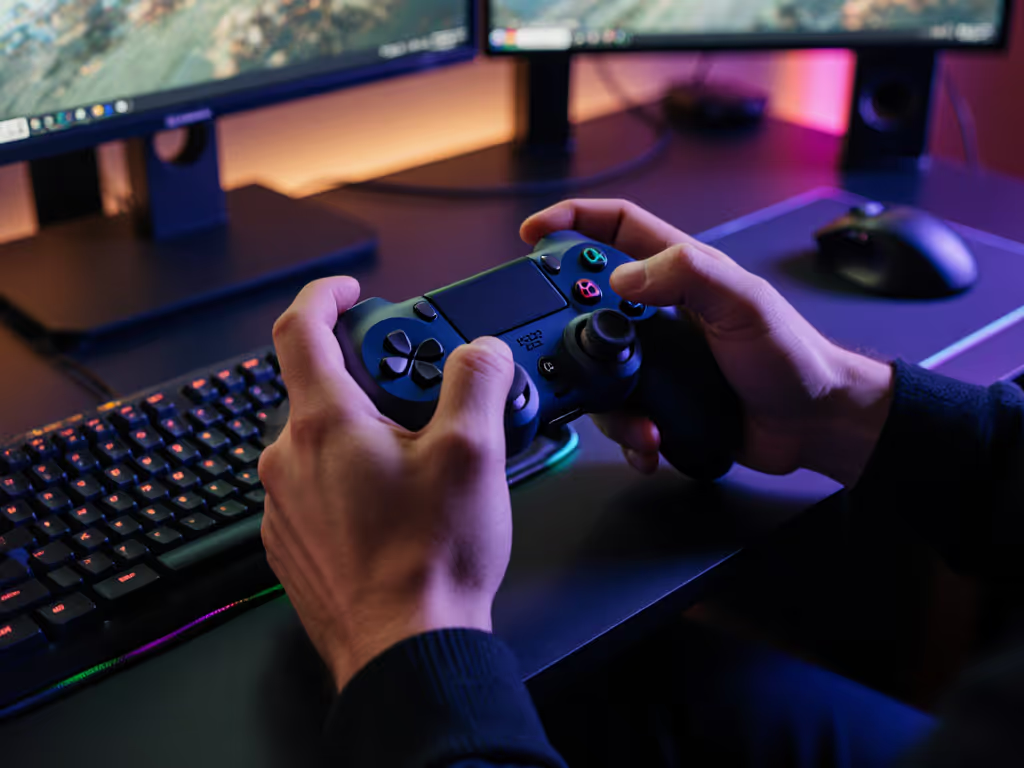
When players talk about "feel," they're usually describing the controller psychology impact on focus and gaming performance psychology (how the device in your hands shapes attention, confidence, and comfort before a single frame is rendered). That "just right" controller isn't only about specs; it alters your cognitive load, perceived control, and even how long you can play before your hands or wrists start to complain.
Comfort buys consistency.
Below is a data-informed FAQ deep dive into how psychology, ergonomics, and controller design interact (and how you can use that knowledge to play better and hurt less).
What does "controller psychology impact" actually mean?
When psychologists and UX researchers talk about controller psychology impact, they're looking at how input devices change:
- Perception of control and agency
- Cognitive workload and attention
- Self-image and in-game personality
- Enjoyment, motivation, and immersion
Studies on controller design show that different input devices (gamepads, motion controls, etc.) shift how players experience a game, including enjoyment and motivation, and even how "agreeable" or "neurotic" they perceive themselves to be while playing.[5][6] That is, your controller quietly nudges how you see your "game self."
Another line of research shows that when a game is easier to control, people free up mental resources for other tasks.[2] In one study, the type of controller influenced how well players recalled brands shown in-game; smoother control meant fewer attentional resources spent just "driving" the character, and more left for everything else (like UI, tactics, or aiming).[2]
Put simply: the more your controller disappears into the background, the more your brain can focus on strategy, prediction, and precision (all the layers that separate casual from competitive).
Controller psychology also intersects heavily with controller ergonomics psychology: how grip shape, weight, and button placement influence both mental state and physical strain.[7] Discomfort isn't just a body issue; it increases distraction, frustration, and decision errors. For hand-health tactics and posture fixes, see our ergonomic controller guide.
How does my sense of control influence gaming performance?
A key part of gaming performance psychology is perceived control (your felt sense of "I can make this game do what I want").
Research on controller variation shows that when the device makes a game feel easier to control, players report a stronger sense of agency and can allocate more cognitive resources to secondary tasks.[2] The controller isn't just a tool; it mediates how competent and "in charge" you feel moment to moment.
Psychologically, this plays out in several ways:
-
Lower cognitive load If you don't have to think about where a button is or fight stiff triggers, you reduce conscious micro-decisions and free working memory for reading enemy patterns and map awareness.[2][7]
-
Higher confidence, less hesitation A controller that responds predictably reinforces your belief that "misses are on me, not the hardware." That confidence reduces second-guessing and stop-start aiming.
-
Reduced tilt and frustration When your inputs feel inconsistent, your brain searches for a cause. If it blames the controller, tilt spikes, even if the hardware is technically fine. A simple, reliable input device reduces that attribution loop.
There is also evidence that gamers as a group outperform non-gamers on several cognitive tasks, especially spatial skills, although much of this advantage shrinks when you account for baseline IQ.[1] That finding hints at a feedback loop: people with stronger cognitive skills gravitate toward gaming, and good input devices then help them leverage those skills under pressure.
If you want your setup to support healthy perceived control:
- Keep your layout consistent across games when possible.
- Use remapping to align with your internal "default" pattern, not what the game assumes.[3]
- Avoid frequent layout changes right before ranked sessions.
Does comfort really affect reaction time and accuracy?
Yes, both physically and psychologically.
Reaction time factors in controller use go beyond raw latency. For protocol-level results, see our Bluetooth vs proprietary wireless latency analysis. They include:
- Movement efficiency: how far your thumb or finger has to travel per input.
- Muscle tension: how hard you need to press to actuate a button or trigger.
- Posture and fatigue: how much strain builds in your wrist, forearm, and thumb over time.
Ergonomics research consistently finds that awkward joint angles, sustained force, and repetitive micro-movements increase muscle fatigue and pain. That fatigue slows movement and degrades fine motor control, even before you consciously feel "tired."
From a psychology angle, discomfort adds background noise to your attention. Pain and numbness demand monitoring; part of your brain is now tracking "Is this getting worse?" instead of "Where's the next threat?" That extra load lengthens decision times and disrupts aim.
Use this quick fit-check while holding your controller in a relaxed, ready position:
- Your wrists stay close to neutral, neither sharply bent up nor down.
- Your thumbs rest on sticks or primary buttons without stretching or collapsing inward.
- Your index fingers can sit on triggers without lifting your palms away from the grips.
- You can press face buttons without your whole hand shifting or gripping harder.
If it hurts, it's costing you frames and fun.
If you notice tingling, burning, or deep fatigue during or after sessions, treat that as a performance issue, not just a comfort issue. Adjust grip, posture, break timing, or device; and if symptoms persist, consult a medical professional or physical therapist rather than "pushing through."
Are pro gaming controllers a real advantage, or mostly placebo?
Pro gaming controllers offer features like adjustable triggers, extra paddles, and customizable stick tension. Psychologically, they can help in three main ways:
-
Custom fit to your habits Extra back buttons let you keep thumbs on the sticks while jumping, sliding, or reloading, removing small but frequent thumb lifts. This simplifies motor patterns and reduces the number of distinct movements you must juggle under stress.[3]
-
Reduced cognitive switching costs With granular remapping, you can align controls across titles, same jump, crouch, and interact buttons everywhere.[3] That consistency reduces procedural memory conflicts (e.g., rolling when you meant to dodge) and speeds up reaction in clutch moments.
-
Boosted identity and motivation Research shows that controller type can change how players experience their in-game personality.[5][6] A controller that feels "built for me" can increase commitment and enjoyment, which indirectly supports skill growth.
However, they are not magic:
- If the controller increases hand strain (e.g., heavier weight, stiffer buttons), you may lose more to fatigue than you gain in features.
- If you constantly tweak settings, you may never let your motor memory stabilize.
- The psychological edge fades if you don't pair the hardware with deliberate practice.
When judging value, ask not just "Is this top-tier?" but "Does this make my inputs more automatic and my posture more sustainable?" If the answer is no, the premium build isn't serving your psychology or your body.
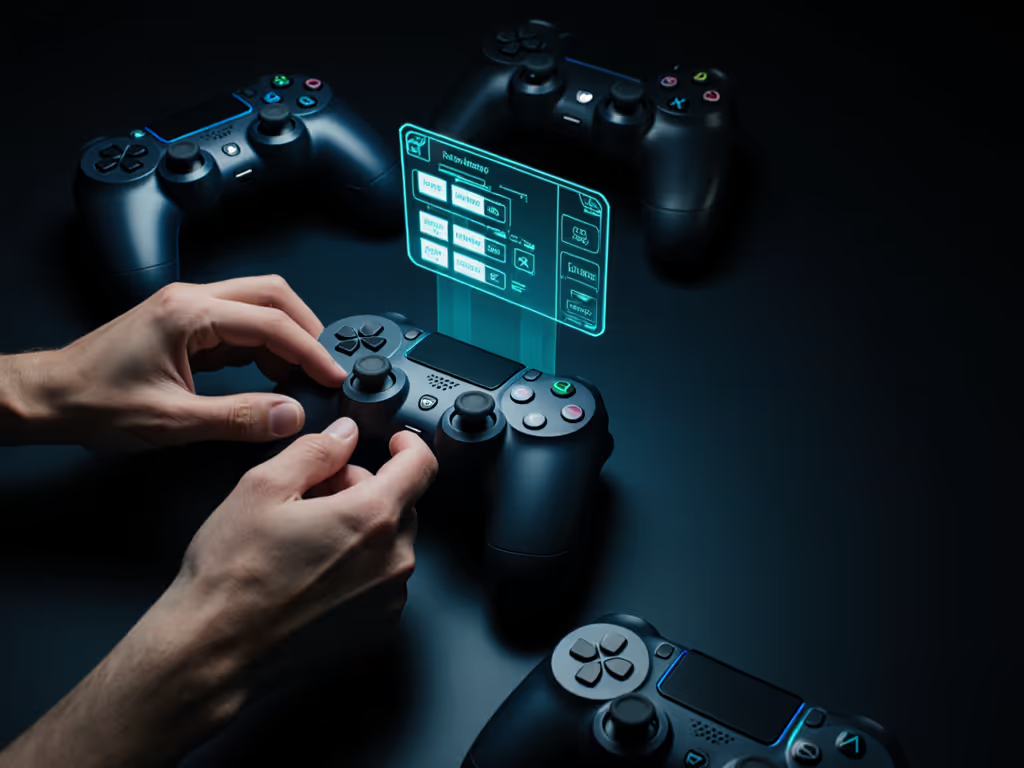
How do button layouts and remapping affect cognitive gaming effects?
Every control scheme imposes a cognitive load: how much mental effort is required to remember and execute actions. Poor layouts increase that load; smart remapping reduces it.
Guidance from cognitive psychology emphasizes that instructions and control schemes should minimize unnecessary working-memory demands so players can focus on the task, not on remembering "which button does what."[8] Similarly, controller-psychology specialists stress that complex controls should be introduced gradually and that full, granular remapping is the cleanest fix for motor habit conflicts.[3] To compare remap tools across brands, see our controller software head-to-head.
Psychologically, remapping helps because:
- It aligns the game with your existing procedural memory (for example, "bottom face button is always jump").
- It reduces mode switching when you move between genres or platforms.
- It lowers the chance of high-cost, low-information errors, like throwing a grenade instead of reloading.
To harness these cognitive gaming effects:
- Standardize a few key actions (jump, crouch, interact, reload) across as many games as possible.[3]
- Avoid separating related functions onto far-apart buttons (e.g., jump on face button, dodge on awkward stick click).
- When learning a new game, add complexity one mechanic at a time, rather than binding everything on day one.[3]
The goal is to let your motor memory carry low-level actions so your conscious attention can stay on positioning, timing, and reads.
Which reaction time factors are truly controller-related versus "skill"?
Reaction performance is a mix of hardware, motor skill, and mental state. Controller-related factors include:
- Input travel and force: deeper, stiffer buttons take longer to actuate, especially at high APM.
- Layout distance: larger stretches between thumb positions add milliseconds and increase error likelihood.
- Consistency of feel: small variations in actuation across buttons or sticks can delay decisions while your brain recalibrates "how hard to press."
Skill and psychology contribute:
- Prediction: skilled players rely less on raw reaction and more on anticipation; good controllers simply let those predictions become actions with minimal friction.
- Arousal and anxiety: over-arousal ("too hyped") can cause overcorrections and twitchy inputs, while under-arousal leads to sluggish reactions.
- Trust: if you distrust your hardware ("this stick drifts, you hesitate, double-check, or overcompensate.
Optimize what you can control:
- Choose a device where all frequently used buttons feel similar in travel and force.
- Minimize awkward stretches for critical actions.
- Stick with one primary layout for competitive play instead of constantly experimenting.
Your hardware should shrink the gap between "I see it" and "I did it," not add another decision layer.
How do I choose a controller that supports both psychology and comfort?
Think of your controller as both a tool and a long-session posture device. You want something that supports neutral wrist posture, efficient thumb travel, and a strong sense of control. If weight balance matters to you, read our controller weight distribution guide.
Use this combined fit + psychology checklist:
Hand and posture fit
- When you relax your shoulders and elbows, the controller naturally sits without needing a tight grip.
- Wrists stay in a neutral line with your forearms, not sharply flexed or extended.
- Thumbs can cover primary sticks and buttons without reaching or collapsing inward.
- Triggers can be fully depressed without your palm lifting off the grips.
Cognitive and emotional fit
- Layout lets you keep key actions on easily reachable inputs with minimal thumb travel.
- You can recreate your "home" bindings across most games (or at least your main genre).[3]
- The controller feels predictable, no surprise stiffness, spongy buttons, or inconsistent actuation.
- You feel calmer and more focused using it, not constantly checking whether it's "messing up."
I have seen players grind a new fighting game, develop worrying numbness, and then watch both their symptoms and dropped inputs vanish after switching to a lighter actuation and slightly wider grip. Their execution didn't improve because they magically got "more talented"; it improved because their device finally stopped fighting their hands.
Give yourself permission to treat comfort as a performance variable, not a luxury. Comfort buys consistency.
For further exploration:
- Track a week of sessions noting when discomfort or "controller doubts" appear and what you were doing.
- Experiment with small layout tweaks and short test sessions in training modes before taking changes into ranked.
- If pain, numbness, or weakness persists, bring your controller and typical posture to a qualified health professional and ask specifically about neutral wrist and thumb positioning.
You don't need the most expensive controller on the market; you need the one that lets your brain focus on the match instead of your hands. When your hardware, body, and psychology are aligned, the game finally has your full attention.
Related Articles