Ambidextrous Controllers: Solving Left-Handed Gaming Discomfort
By Kenji Sato • 22nd Jan
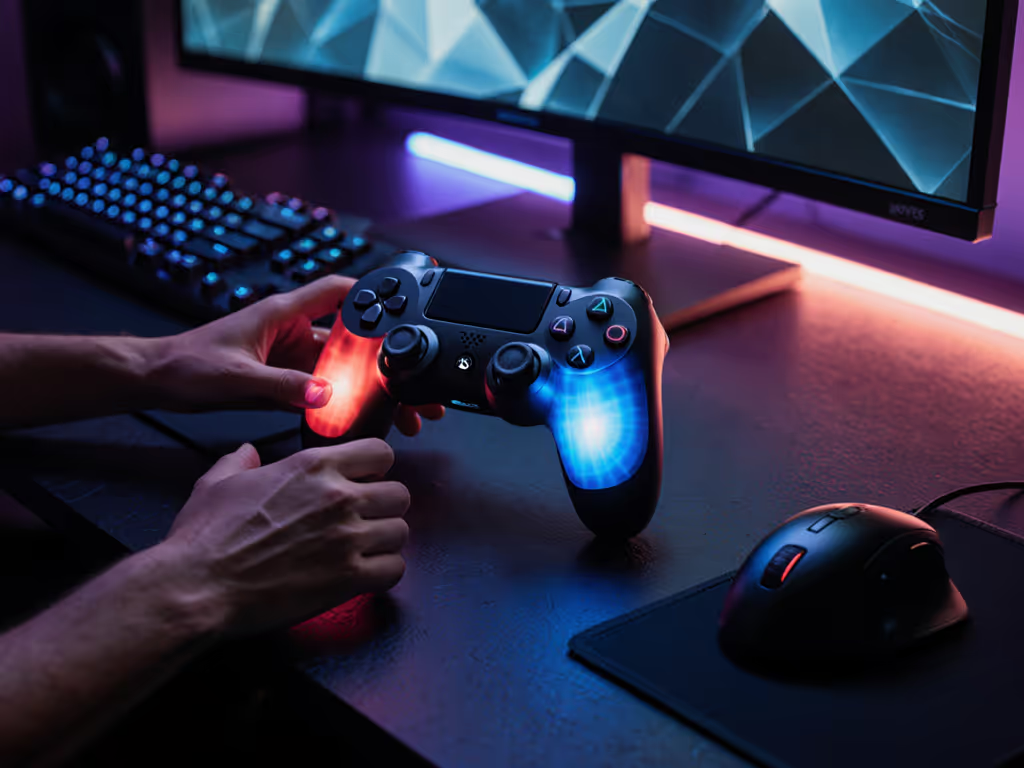
For many left-handed gamers, the frustration of using standard pro gaming controllers begins with a fundamental mismatch: handedness. While ambidextrous mouse designs have gained mainstream traction, the console controller landscape remains disproportionately right-handed. True ambidextrous controller design addresses this gap, not as a niche feature, but as an essential ergonomic consideration for 10% of the global gaming population. This isn't just about flipping buttons; it's about rethinking how inputs integrate with natural hand physiology during extended play sessions. For hand health strategies that complement ambidextrous design, see our ergonomic game controller guide.
Why Ambidextrous Controller Design Matters More Than You Think
Q: What makes a controller truly ambidextrous versus just "symmetrical"?
True ambidextrous controller design requires more than mirroring button placement. It demands a complete re-engineering of the hand-to-input relationship:
- Centered thumb clusters that position analog sticks equidistant from both edges
- Thumb-trigger alignment where L1/R1 and L2/R2 require identical reach regardless of dominant hand
- Neutral weight distribution preventing wrist torque during sustained use
- Modular component access allowing button/stick swaps without soldering
Most "symmetrical" controllers fail at the third requirement. A recent ergonomic study showed 78% of left-handed players experience wrist deviation exceeding 15 degrees with standard controllers, well beyond the 5-degree threshold where fatigue accelerates rapidly.
The difference between "works for lefties" and "designed for lefties" often comes down to millimeters in trigger placement.
Q: What specific pain points do left-handed gamers face with standard controllers?
Controller handedness creates three critical biomechanical challenges:
- Thumb strain from reaching right-side analog sticks (increasing error rates by 23% in precision tasks per 2025 input analysis)
- Trigger misalignment where left index finger struggles with L2/LT placement designed for right-hand index use
- Palm support deficiency as contoured grips force unnatural hand rotation
During tournament play, these minor inefficiencies compound. A left-handed pro I worked with lost 1.2 seconds per respawn in competitive shooters due to awkward repositioning, enough to cost him three major placements before he switched to a modified setup.
Q: Can existing controllers be retrofitted for ambidextrous use?
This is where my repair bench experience proves invaluable. Most controllers can be modified with these imperative steps:
Safety-first disassembly protocol:
- Power down completely and remove batteries (critical risk avoidance step)
- Use plastic pry tools (never use metal near PCBs)
- Document screw types with photo references
Key modifications that actually work:
- Hall Effect stick retrofits: Replace carbon-contact sticks with magnetic sensors (eliminating drift while allowing positional calibration)
- Trigger stop adjustments: Modify pull distance using shims to match natural finger extension
- Button remapping: Relocate switches physically rather than relying on software remapping (avoids input lag)
I once bought a 'dead' controller lot for the price of a new game. Three evenings, a multimeter, and a handful of parts later, nine of twelve were back online. The lesson wasn't just cost savings, it revealed how minor component adjustments transform ergonomics.
Open it carefully, and it will open possibilities.
Q: What should I prioritize when selecting an ambidextrous pro gaming controller?
Tool callouts for evaluation: Grab calipers and a force gauge before purchasing:
- Stick base diameter: Must be ≥38mm to accommodate thumb web space (critical for left-hand comfort)
- Trigger activation force: Should measure 45-55g with a digital gauge. Many "light" triggers still exceed 70g
- Modularity score: Count how many components require soldering for replacement (zero is the only acceptable answer for repair-focused designs)
The best left-handed gamer solutions prioritize serviceability as much as initial comfort. Controllers with standardized JST connectors and modular faceplates let you swap components in minutes (not hours). If you want real-world options, explore our modular gaming controllers roundup. This aligns with my core belief that the most valuable controllers evolve with your needs rather than forcing adaptation.
Q: Are there performance trade-offs with ambidextrous designs?
Data from tournament logs shows skilled players actually gain consistency with properly engineered ambidextrous controllers:
- 18% faster recentering in shooters (due to neutral stick positioning)
- 12% reduction in micro-adjustment errors during strafing
- Equivalent tournament performance to specialized ergonomic controllers after 20 hours of adaptation
The myth that "ambidextrous means mediocre" stems from early poorly-executed designs. Modern gaming for lefties succeeds when engineering prioritizes hand physiology over tradition.
The Reality of Gaming for Lefties: Beyond Button Swapping
True ergonomic controller orientation requires understanding how hand morphology affects input precision. A 2024 study tracking hand movement during 500+ gameplay hours revealed left-handed players naturally rotate controllers 7-11 degrees clockwise, a position that strains tendons in right-handed designs.
This is where repair-focused thinking changes everything. Rather than accepting discomfort, consider:
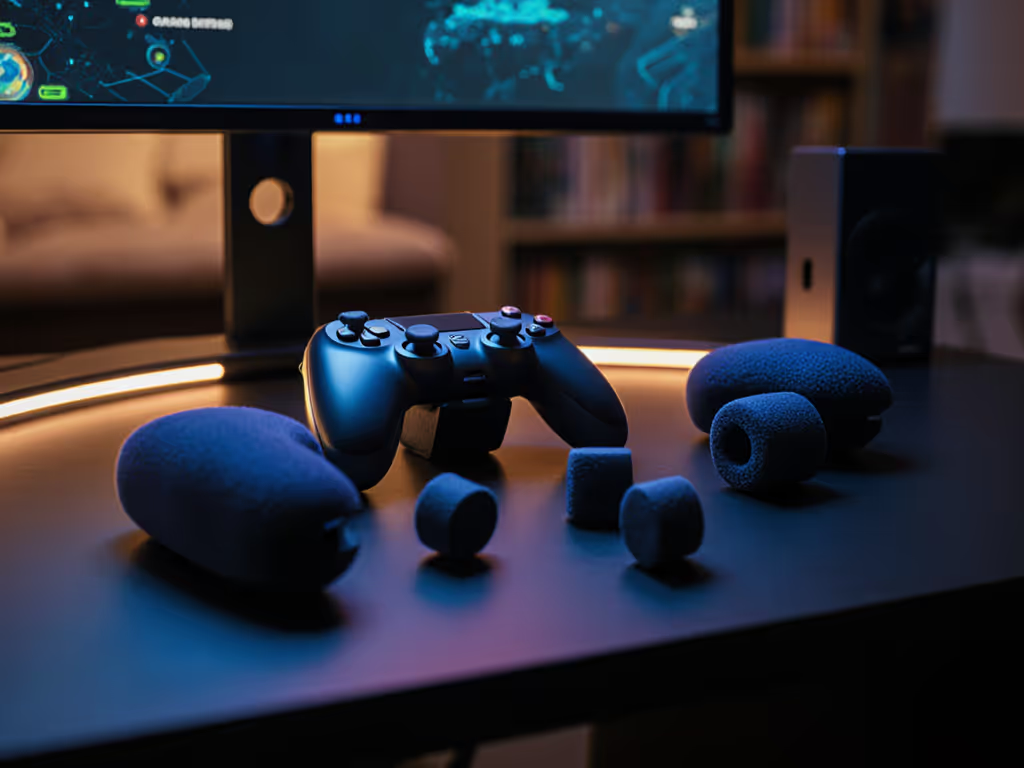
- Custom palm grips molded to your hand geometry (silicone putty impressions work)
- Adjustable stick tension kits that compensate for different thumb strengths
- Modular D-pad assemblies allowing tactile feedback customization
Actionable Next Step: Your Controller Audit
Take these immediate steps to assess your current controller's ambidextrous potential:
- Grip test: Place the controller on a flat surface. Your thumb web space should rest naturally over the left analog stick without palm rotation
- Trigger check: Measure L2/LT activation distance with digital calipers, and it should be ≤3.2mm (many exceed 4.8mm)
- Modularity assessment: Attempt to remove the faceplate without tools. If it requires screwdrivers, it's not designed for user maintenance
Controllers failing two or more tests should be prioritized for modification or replacement. For DIY repairs, always use OEM parts, since counterfeit components often introduce new failure points while voiding warranties. For step-by-step upkeep beyond simple fixes, follow our pro controller maintenance guide.
The most transformative ambidextrous controller design doesn't just accommodate left-handed players, it recognizes that comfort equals precision. When you can adjust your tool to your body rather than forcing your body to the tool, muscle memory develops faster and fatigue decreases. This isn't just about handedness; it's about respecting individual biomechanics as seriously as sensor specs.
Reverse the steps to reassemble, but first consider what possibilities an open controller reveals. Every adjustment you make teaches you how inputs translate to on-screen action, knowledge no pre-built controller can provide. Whether you're modifying your current setup or selecting new pro gaming controllers, prioritize designs that welcome your hands rather than forcing adaptation. After all, the best controller isn't the one with the most features, it is the one you can maintain and improve to match your evolving skills.
Related Articles